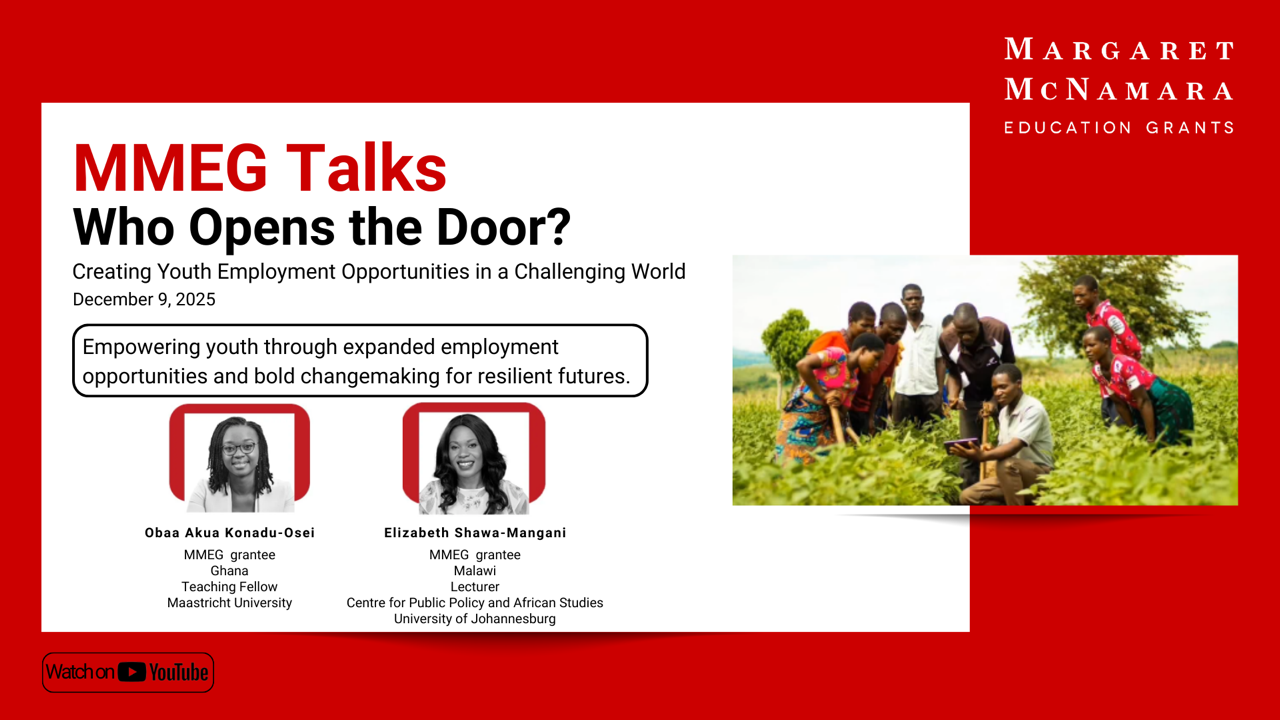
The final MMEG Talks of 2025 offered insights on how to open pathways for youth employment through holistic, inclusive solutions. In a webinar on December 9, 2025, MMEG grantees Obaa Akua Konadu-Osei (2021, Ghana) and Elizabeth Shawa-Manganii (2018, Malawi) reflected on the challenges young people face today and the systems that continue to shape their futures.
Youth unemployment remains one of the most pressing global issues. This conversation brought together two MMEG grantees whose work and experience reveal just how complex and urgent this challenge truly is.
The discussion underscored that solving youth unemployment requires a holistic approach, integrating gender equity, supportive ecosystems, and systemic reform. This theme emerged repeatedly as the speakers unpacked the realities facing young people, particularly young women, across the African continent.
Elizabeth Shawa-Mangani, a lecturer and researcher whose work spans youth unemployment, land reform, and agriculture, spoke to the structural issues young people encounter when seeking meaningful work. Drawing on her research in Malawi and beyond, she noted that entrepreneurship is often presented as the primary solution to unemployment. Yet this approach falters when the foundations needed for success—reliable infrastructure, access to patient capital, and attention to local markets—remain out of reach. Even the most motivated young people cannot build a livelihood upon systems that do not support them.
Obaa Akua Konadu-Osei, an academic and practitioner focusing on youth development, women’s empowerment, and human capital development in Africa, highlighted the persistent gender barriers that shape young women’s access to employment. She emphasized that discussions about youth employment cannot be separated from gender equity. Unpaid care work, stereotypical expectations, and pressures placed on women in professional spaces continue to limit their participation in the workforce. For many, entering and staying in dignified work requires compromises that often go unrecognized in policy and practice.
Together, the panelists pointed to additional systemic issues that reinforce inequality: fragmented policies, credential inflation, and education systems that are not aligned with the realities of contemporary labor markets. These gaps leave young people simultaneously overqualified and under-supported, navigating pathways that were never designed with them in mind.
Yet the conversation also illuminated the strength, resilience, and commitment young women bring to transforming their communities. Both speakers have dedicated their careers to rethinking how systems can better serve youth, and their contributions underscored why MMEG’s support for women in development fields matters so deeply.
This final session reaffirmed how much MMEG TALKS contribute to our mission by bringing forward the expertise and experience of our remarkable grantees. We applaud them for continuing to lead and inspire, and we hope others will join us in 2026 as we expand this space for learning, connection, and impact.