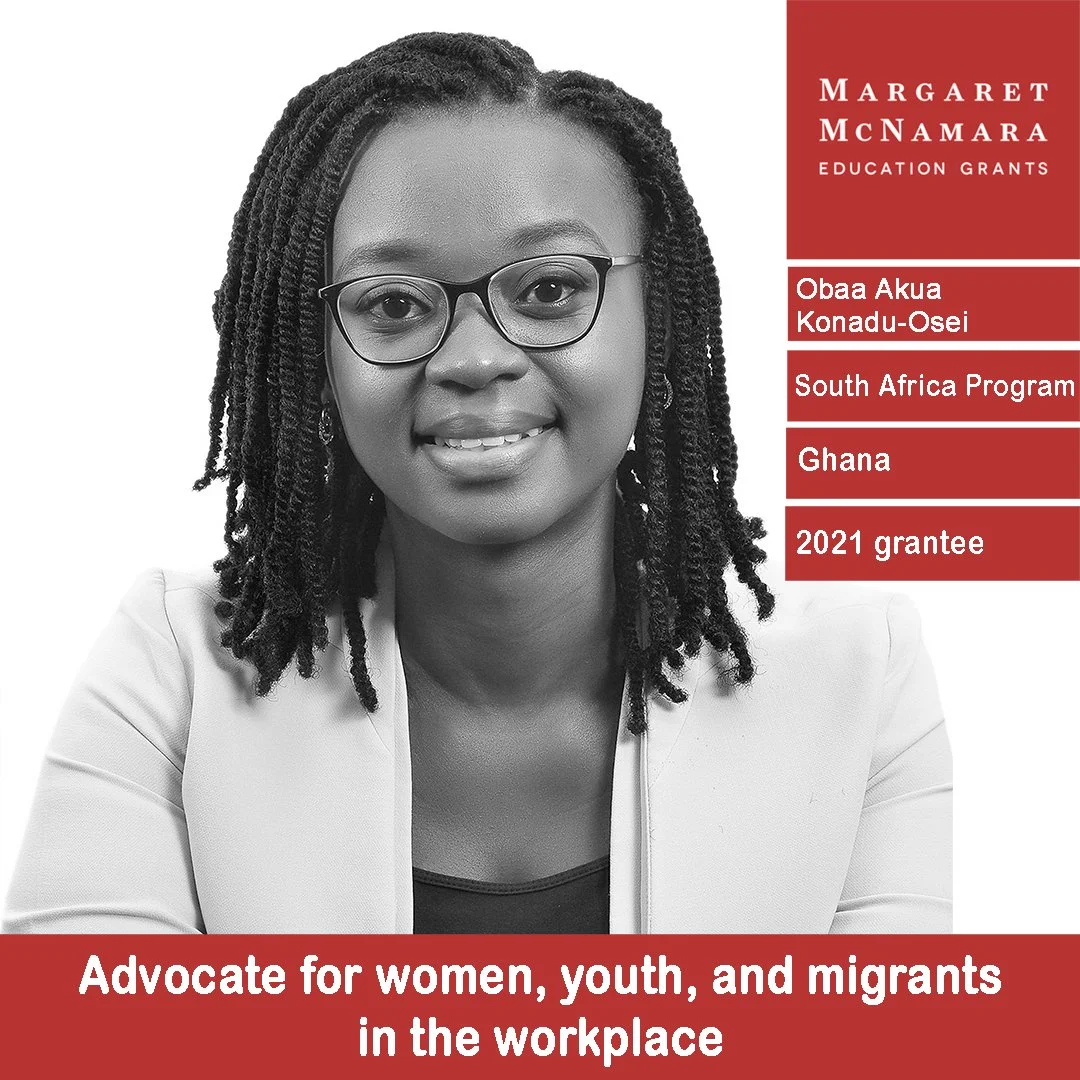
When I received the Margaret McNamara Education Grant in 2021, I was a Ghanaian doctoral student in the final stages of my PhD program at Stellenbosch University in South Africa. I was far from home, navigating the complexities arising from COVID-19, and driven by a singular conviction: that research on gender, youth, and development in Africa needed to center more African voices. The MMEG grant not only provided financial resources to further my research; it also validated my conviction and gave me the confidence to pursue my work with renewed purpose.
Completing the PhD
I completed my PhD in business management and administration in 2023. My doctoral research, titled “The development of positive work identities of women in male-dominated jobs,” explored how women navigate (multiple) marginalized identities in traditionally male-dominated workspaces. The study made three key contributions: i) challenged dominant research paradigms, arguing for methodological decolonization and the centering of local epistemologies; ii) highlighted the non-linear, fluid, and complex processes women engage in as they create alternative ways of existing in traditionally male-dominated spaces; and iii) demonstrated how formal and informal workplace structures are necessary (and also potentially limiting) in ensuring women’s upward career mobility in the workplace.
My work on methodological decolonization has since been published in the Journal of Business Ethics and, most recently, in Qualitative Studies (2026); a continuation of my commitment to reshaping how research is done, not just what it studies. I have co-authored an article on women's identity in male-dominated workplaces, published in Gender, Work & Organization (2025). These publications reflect my belief that academic work must speak to real-world inequalities.
Post-PhD
Since graduating, I have been a teaching fellow at Maastricht University in The Netherlands, tutoring courses such as Urban Development and Poverty, Migration and Citizenship, Gender and Development, and Qualitative Research Methods. I also sit on the Global Studies’ Board of Admissions.
Teaching at a European university has been both a rewarding and thought-provoking experience. I am conscious of what I bring to the classroom—not just the content I teach, but the perspectives I carry as someone trained in Ghana, the United Kingdom, and South Africa. I work to ensure that African contexts and ways of knowing are treated as substantive contributions to global conversations, rather than as illustrations.
Policy, advocacy, and applied research
The MMEG grant came at a moment when I was already deeply involved in policy-relevant research. In 2022, I worked as a gender and youth specialist consultant for the World Bank, contributing to the Gambia Human Capital Review and informing the country's 2023–2032 strategic plan for women's economic empowerment. That experience reinforced for me that the gap between academic research and policy action is not inevitable; it is a choice, and I choose to bridge it.
In 2023, I received an independent research grant from the European Partnership for Democracy to study youth political participation in Ghana. More specifically, I explored the cost of politics in Ghana using an intersectional lens that considers youth, gender, and political-party membership of parliamentary aspirants. In 2025, I also served as a country consultant for Ghana, contributing data across political, civic, and social dimensions to the Global Youth Participation Index. I currently consult for the Governance and Development Advisory, leading their gender, youth, and migration research portfolio.
Continued academic research and fellowship
I have been awarded research grants from Maastricht University's Faculty of Arts and Social Sciences Research Stimulation Fund and the Nanne de Vries Professor's Fund toward a research project that explores cultural and religious influencing on parenting practices among highly skilled African migrants in the Netherlands.
I have presented my work at the World Bank, the Gender, Work & Organization Conference, the Dutch Black Scholar and Expert Conference, MACIMIDE Annual Work Conference, and MMEG Talks (2024 and 2025). I have also given back as a reviewer for a number of academic journals.
What the grant meant and still means
The MMEG grant came at an important moment in my academic journey; providing not just financial support, but also a meaningful vote of confidence in the work I was pursuing. Being selected by an institution that invests in women from developing countries reinforced my commitment to research that is rigorous, relevant, and grounded in the communities it seeks to serve.
That sense of purpose continues to guide my work; whether in the classroom, in research, or in the advisory spaces I occupy. There is still much to do, but I am grateful for the contribution of the grant.