
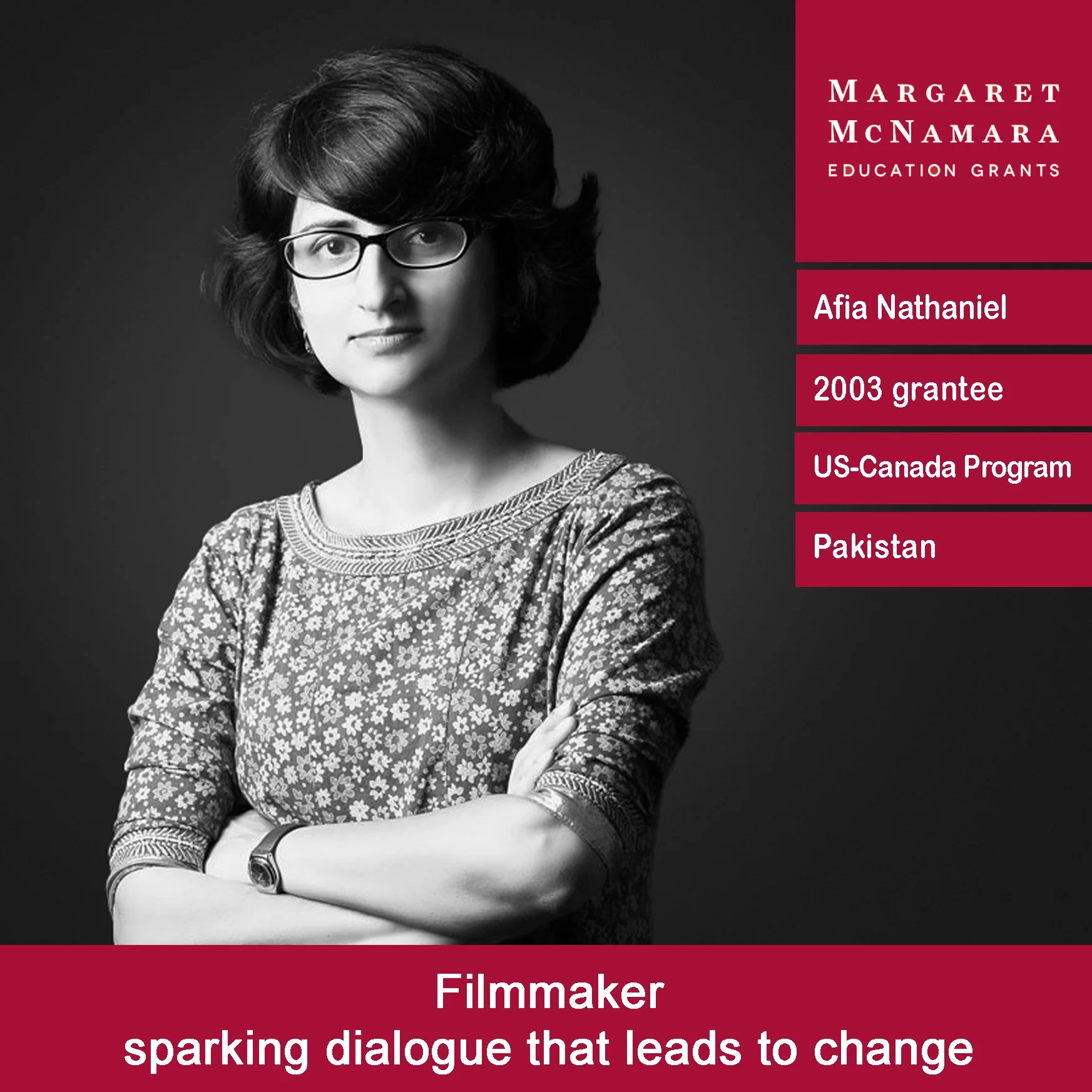
“Thanks to MMEG, I not only found my voice as a storyteller, I found a way to spark dialogue and conversations that can lead to change.”
Raised and educated in Pakistan by two grandmothers and a great-grandmother, Afia Nathaniel grew up with stories of women hiding in plain sight. Their everyday sacrifices were seared in her mind as she left Pakistan for an internship with the World YWCA in Switzerland. Working with an international women’s non-profit further opened her eyes to the power of women’s stories, inspiring her to think about filmmaking as a career. She became a student of light and life, training herself as a photographer and a screenwriter. In 2001, she was accepted in Columbia University’s MFA Directing program as a Dean’s Fellow and has since then focused on telling women’s stories for the big and small screen.
MMEG awarded Afia a $15,000 grant in 2003 to support the pursuit of her studies at Columbia University. Afia says: “being able to complete my MFA in film directing was a life-changing experience. I not only found my voice as a storyteller, I found a way to spark dialogue and conversations that can lead to change.”
Afia explores pressing social justice issues of our time, often difficult ones like child marriage, fundamentalism, and gender-based violence in the context of patriarchal cultures and how it affects identity of the self and humanity.
Afia’s debut feature film, Dukhtar (Daughter) – a road trip thriller about a child bride – premiered at the Toronto International Film Festival in 2014 and was Pakistan’s Official Submission for Foreign Language Film at the 87th Academy Awards®. It played to critical acclaim in over 20 countries and became the Critics’ Pick (Village Voice) and the People Magazine’s Pick of the Week.
Her latest film, “Don’t Be Late, Myra,” has won several awards and is now Oscar®️ qualified. The film takes an unflinching look at the issue of sexual assault of children. The protagonist’s journey makes us aware of the stigmas surrounding gendered sexual violence in patriarchal societies and poses larger questions about how women and girls can break this cycle of violence.
Since receiving a MMEG grant, Afia has won numerous awards and honors, including from the Hubert Bals Fund (2008), Geri Ashur Screenwriting Award NYFA (2010), Sørfond Grant (2012), New York State Council for the Arts (2013), Princeton Arts Fellow (2016–18), NBCU Launch Female Forward Fellow (2020), and Disability Belongs Lab Fellow (2025).
Alfia is currently working on several projects, all focused on the theme of patriarchy, the overt and covert ways women resist it, and how women find their agency on their own terms. Her powerful stories of resistance and resilience will continue to inspire women and children worldwide and help dismantle the barriers of patriarchy, one film at a time.