MMEG Annual Arts & Crafts Fair, Tues Nov 14 - Thurs Nov 16, 2017

The Margaret McNamara Education Grant (MMEG) Annual Arts & Crafts Fair,

Tuesday November 14 through Thursday November 16, 2017, 10am – 4pm each day,

World Bank Main Complex (MC) Building (Glass Lobby and Preston Auditorium)*
IMG_4614.JPG

The MMEG Annual Arts & Crafts Fair will open to WBG staff and the general public (photo ID required to enter) from Tuesday November 14 through Thursday November 16. This will be the 34th annual Fair. While many WBG staff members may have seen the words “Shop for a cause!” plastered around the World Bank, and while many of these staff, and visitors from outside the Bank, have certainly flocked to the Fair over the years, you may not know why this Fair is held, the history behind it, or its unique place at the World Bank.

Here are a few facts to motivate you further as you shop!

·        Since its inception in 1981 through this year, MMEG has disbursed $3.1 million for 351 education grants to women from developing countries pursuing university studies. In FY17, we awarded 33 grants to exceptional women from 21 different countries, divided almost equally among three continents: North America, Africa and Latin America.

·        MMEG is an all-volunteer organization. We receive ongoing support, in-kind and otherwise, from the World Bank, the World Bank Family Network and dedicated MMEG and WBFN volunteers. Funding for MMEG grants comes essentially from two sources. First and foremost, direct monetary donations from World Bank Group staff and retirees, private individuals and a few external foundations for which we owe grateful thanks; and secondly, fundraising activities, the biggest of which is the Annual Arts & Crafts Fair. The Fair has generated valuable revenues for MMEG for over 30 years and is a significant way in which we fund our mission. In 2016 and 2017, Fair income accounted for an average of 22% of total grant funding.
IMG_4522.JPG

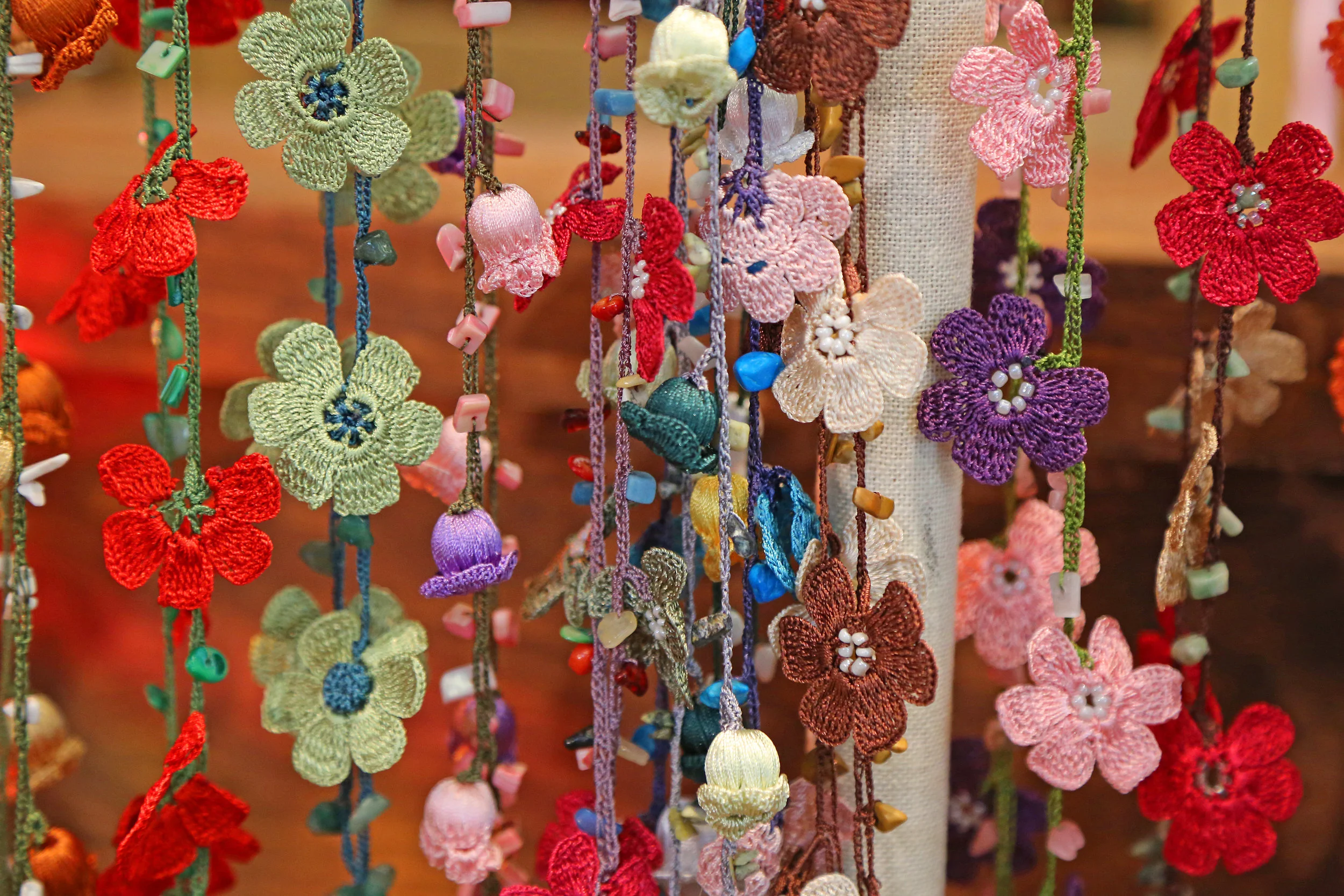
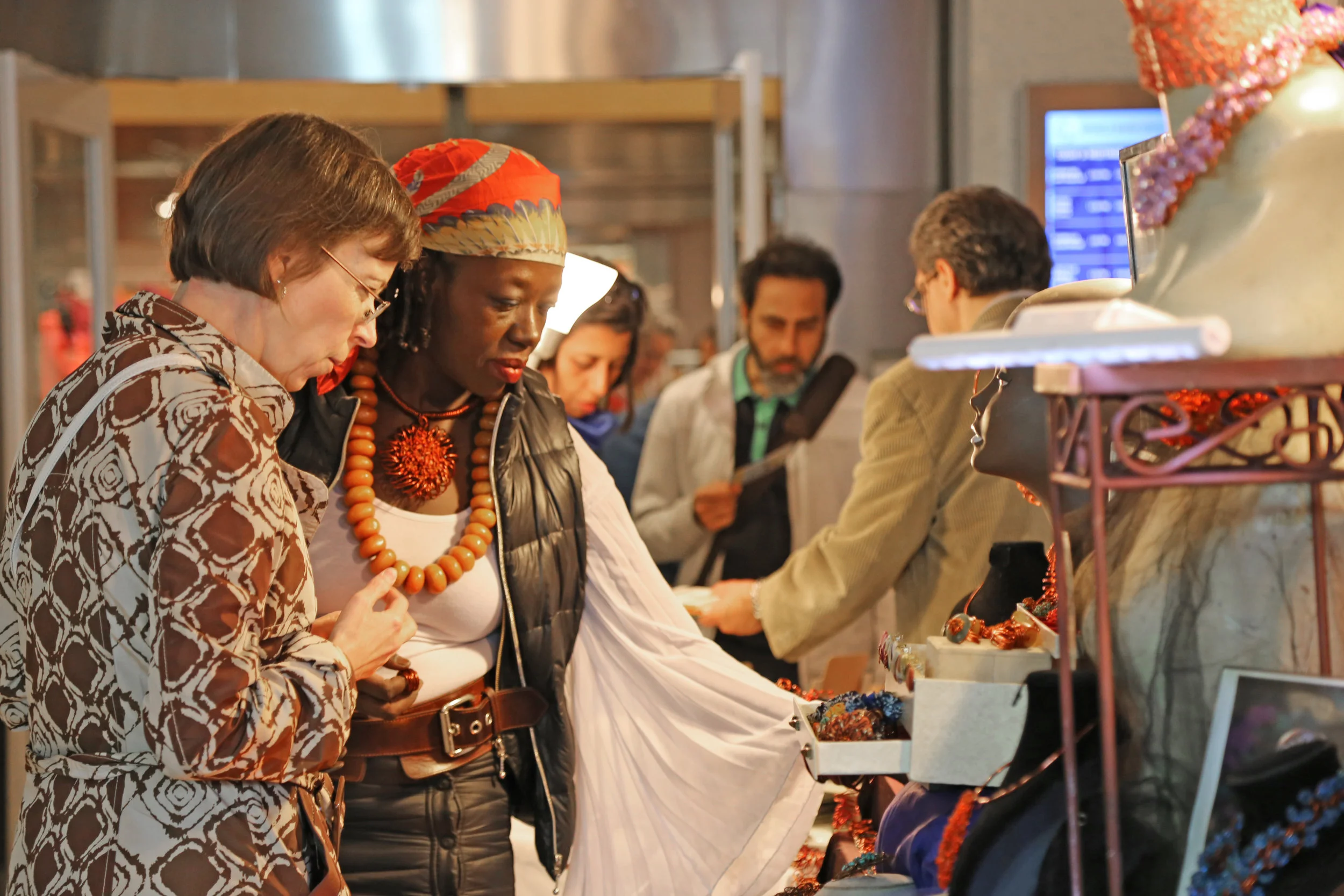
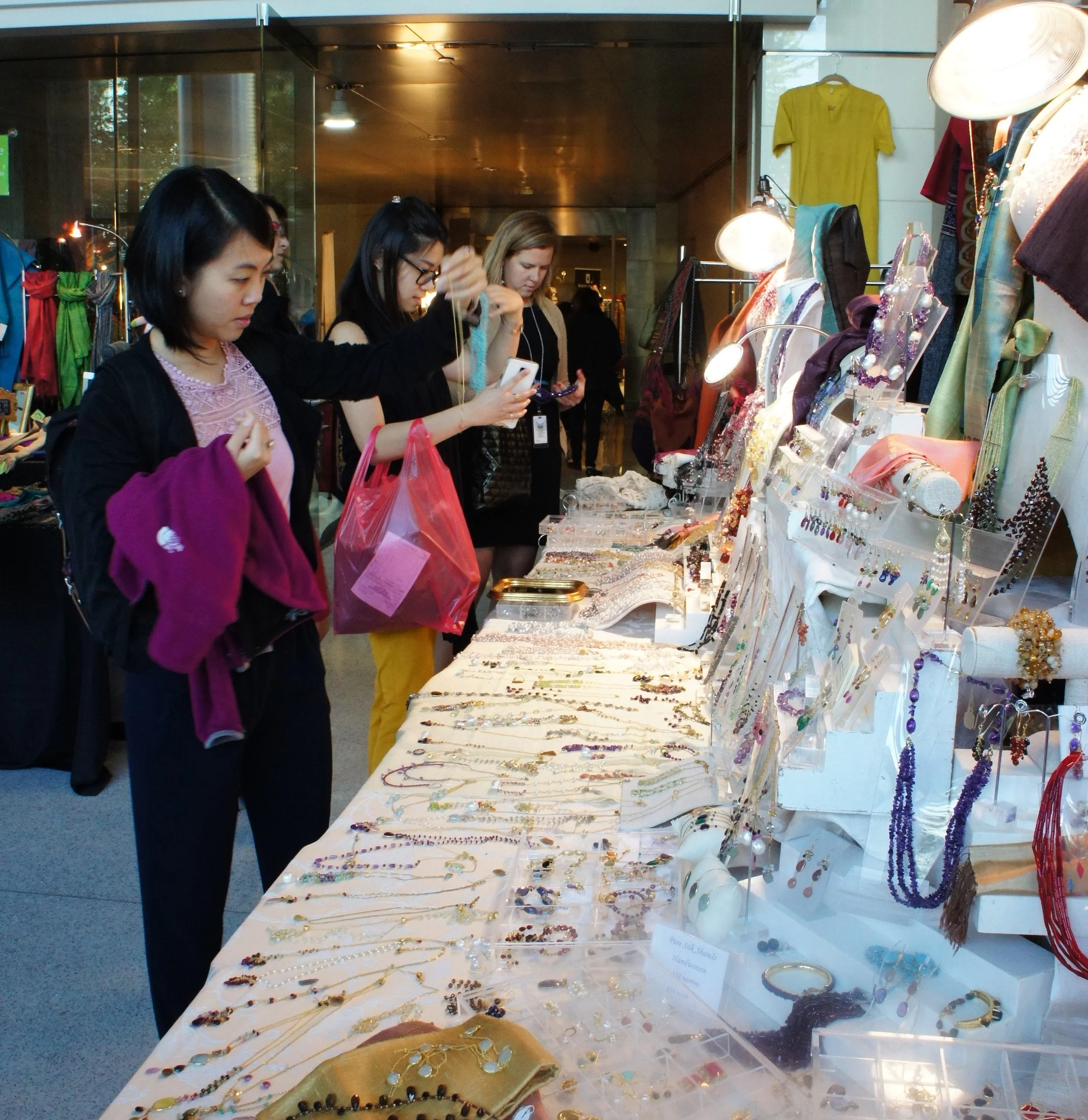
As we know it today, the Fair is a bustling, festive event. It is colorful, animated and often exotic. Items sold range from spectacular jewelry, silk scarves, fancy hats and clothes to gourmet chocolates and tableware. There is a gourmet table where hungry shoppers can enjoy snacks from all over the world – samosas, Turkish boreks, sushi, savory and sweet pastries and sandwiches are some of the goodies on sale. One of the first tables that shoppers see as they come in is MMEG’s treasures table. Items sold at this table are all donations made to MMEG – by MMEG and WBFN volunteers, as well as from the Bank.  There is something for everyone!

The Fair is the brainchild of then MMMF (Margaret McNamara Memorial Fund) Committee member Carla Scearce. Carla’s idea led to the holding of a bazaar in a church in Virginia in October 1984. Items left over from this first bazaar were then sold a couple of weeks later at the World Bank. The bazaar and sale netted a total of $7,600 for the MMMF, substantially more than any previous event. The bazaar grew exponentially the following  year, and in 1986, it became the "International Arts and Crafts Fair'' and was held in the World Bank’s H Building Auditorium.  The Fair has been held every year since then. In 2009, with the closure of the World Bank’s H building offices, the Fair moved to the Preston Auditorium in the MC building. This move gave the Fair access to a bigger, more open space that was easier to find and provided easier access for the general public, substantially raising the profile of the event.
DSC02128.JPG

Today, the Fair is MMEG’s main fund-raising activity. In addition to the funds it generates for grants, it significantly increases MMEG’s visibility in the Bank and with the public. It is a fun and productive event that motivates volunteers, creates camaraderie, and even long-lasting friendships. To quote Caroline Berney, who took over chairing the Fair from Carla Scearce in 2002, the Fair is “more than the sum of its parts”. It is a big event that cuts across many offices of the World Bank:  the President’s Office, the General Services Department, Bank moving, security, fire safety, and cleaning staff all contribute to making it a successful event. The Fair would not be possible without any of these actors and we owe them our sincere thanks!

Organizing the Fair is a challenging, cooperative endeavor that brings together some 50 to 60 MMEG and WBFN volunteers every year.  These include: the organizing Fair committee, “runners” to collect and tally sales receipts during the event, salespeople to man the gourmet and treasure tables, and helpers to set up, take down and clean up. Georgine Ahmad, Fair Chair from 2010 to 2014, notes that the Fair is “a real enterprise”. It is a huge job that requires extensive preparation and multiple backup plans.

All of these efforts are geared toward one goal: raising money to fund education grants. The money raised comes from a percentage of sales from vendors, flat fees for vendor participation and sales from MMEG-sponsored treasure and gourmet tables. Last year, proceeds from the Fair funded 8 of our 33 grants. To make our goal and results more concretely tangible to visitors to the Fair, most years one or more grant recipients are invited to attend the Fair to meet vendors, shoppers and volunteers. This year, two 2017 grantees will be attending:  Singmila Shimrah, a PhD student at George Mason university who is working on peace processes in armed conflict, and most particularly the challenges of women’s participation in the peace and dialogue process in the Naga conflict; and Veronique Taylor, a nursing student at Trinity Washington University, who is committed to working with women and children to make healthy lifestyle choices, avoiding unhealthy relationships and bad habits such as drinking, smoking and drug use.

We warmly invite you, WBG staff as well as friends and holiday shoppers outside the Bank, to visit the MMEG Annual Arts & Crafts Fair. It is a great place to browse during your coffee break or lunch hour, pick up unique holiday gifts before the rush starts, or even spoil yourself with something beautiful and unexpected. It is also a wonderful opportunity to meet two MMEG grantees.

And above all, shop for a cause!

Support extraordinary women to achieve extraordinary results! 

Sincere thanks to long-time Fair Chairs Caroline Berney and Georgine Ahmad for providing historical context and background on the organization of the Fair.


*  World Bank Main Complex (MC) Building, 1818 H Street, NW, Washington DC 20433.

Providing Comfort on a Park Bench: The Power of Human Contact

This story of inspirational women is not from a grantee, but from one of their countries.  “Grandmothers” have been trained to address some mental health issues in Zimbabwe, where only 13 psychiatrists are available to serve a national population of 14 million.

Screen Shot 2017-10-03 at 9.56.40 AM.png


“On any given afternoon in the capital of Harare and nearby cities, an elder woman can be found on a bench outside a clinic, listening intently to another person’s stories. She’s affectionately called a “grandmother”… for her role offering comfort, encouragement and a ready ear,” for those who may feel (in Western terms) depressed. The women are also trained to recognize who might need more advanced care at a health facility.

Dixon Chibanda, one of the psychiatrists who co-developed the program to hone  “mental health care down to basic human connections”, made medical concepts accessible in laymen’s terms, and enlisted women to create “friendship benches” where problems could be resolved at community level. Research shows that social support methods can help treat mental illness.

The Zimbabwe story also reminds us that education continues beyond universities, and that women of all ages continue to contribute to the well-being of their communities.

posted by Reiko Niimi

Why "Slumdog Millionaire" is One of My Favorite Movies

By Reiko Niimi

Work1.jpg

Personal story

“Slumdog Millionaire is one of my favorite movies, because its message -- based on the coming-of-age story of two brothers in India -- has always resonated powerfully: “You can be what you want!” Born in Aguascalientes, in rural Mexico, from an early age, I have both questioned and believed in the truth of that phrase.
I am the second child of four raised by a strong mother. The long absence of my father and the macho, class-conscious society in which I grew up has no doubt contributed to building my resilient character.  I grew up hearing that there was “no money for studies, so work and earn money” or more frequently, that without a (financially) supportive family  “Who can take you seriously?” Under these circumstances, I saw two options: either adapt and accept my daily reality, or counter this social paradigm with determination. I have always had to work while studying, sometimes more than 16 hours a day. This has impacted the time it takes to complete my coursework and obtain degrees, but I am not giving up; I still work for my goals!
JUSTICE is the key word underlying my doctoral thesis. A professor advised me to identify a research topic that I could feel in the pit of my stomach. So I decided to focus on the difficulties faced by women in my socio-economic situation and from rural areas to access higher education. I am linking education theory, practice and results, in order to reduce the obstacles to education and justice, currently confronted by vulnerable youth, especially indigenous women.”

Mariela Escobedo has given us permission to translate and share the above from her successful application for a grant from MMEG in 2017. After graduation from Universidad Iberoamericana in Mexico, she intends to organize an NGO that advocates access to education for marginalized women.

Obstacles confronting indigenous women

Mariela’s preliminary research shows:

  • The indigenous population in Mexico is more than 6 percent of the population, or 7 million people (INEGI, the National Institute of Geography and Statistics in Mexico).
  • 16.5% of the population, 15 years or older, have at least one year of college, and an equal proportion of women and men were enrolled in 2003 (Cordoba, 2016).
  • However, only 2.8% of the indigenous population in Mexico reached higher education in 2010. Only one in four of them are women.

Education policies regarding indigenous inclusion have focused at the primary level, particularly basic literacy (Chavez,2008). Despite this success, they do not have the same support to continue their education. Mariela’s research shows that Indigenous students fail to pass university admission exams, because of deficiencies that accumulate in high school. Women are further discouraged by community expectations, such that a college acceptance and scholarship may be declined out of family concern for her safety and social risks (e.g. unwanted pregnancies and sexual abuse) -- compared to encouragement for men to seize such opportunities. She believes that the benefits of higher education must thus be promoted through community-level awareness-raising programs, in order to increase the number of women in higher education.

Even after arriving at a university, despite the odds, indigenous women face linguistic discrimination (since Spanish is not their mother tongue), social ostracism, and lack of role models. There are few scholarships for the indigenous population, and no university programs that promote the retention of indigenous students, especially during their first year --a period that is crucial for continuing studies up to graduation.

We are proud that Mariela is looking for ways that public policy in Mexico can improve access to higher education for indigenous women! 

----------------------------------

REFERENCES

Data of indigenous population in Mexico:

http://cuentame.inegi.org.mx/poblacion/lindigena.aspx?tema=P

Distribution of student population in higher education, Mexico:

Cordova, Martha, (2016), La mujer mexicana en la educación superior. https://psicolatina.org/Cuatro/mexicana.html

http://www.scielo.org.mx/scielo.php?script=sci_arttext&pid=S0185-27602008000400003

Research of Eugenia Chávez about indigenous students:

Chávez Arellano, María Eugenia (2008).  Ser indígena en la educación superior ¿desventajas reales o asignadas?,vol.37, pp.31-55.:

http://www.scielo.org.mx/scielo.php?script=sci_arttext&pid=S0185-27602008000400003


Insuring Women's Safety

Although she grew up in a safe and loving family, Farzana Chowdhury personally knows the many socio-economic challenges facing women in Bangladesh. And she passionately wants them to know that “You’re not alone.”

First female CEO of Green Delta and in the Bangladesh insurance industry, Farzana was recently honored by the United Nations Global Compact in a Times Square event for her pioneering contributions to the dignity of women and poverty alleviation. This year, she launched a product called Nibedita to literally insure women’s safety, regardless of economic stature, that includes a smartphone app that provides a counseling network, emergency services and safety tips.

Traditionally, women are not encouraged to claim damages after suffering trauma or being victimized (by rape, for example). Green Delta’s personal accident insurance helps to empower women, and to promote gender equity.

Farzana learned about MMEG during discussions with the IFC (International Finance Corporation of the World Bank). She generously donated to the scholarship endowment, and offers mentorship possibilities to grantees from Bangladesh or those in the finance industry.

Press Release: "Empowering Women Reception and Fundraiser" to Support Women’s Education

The Margaret McNamara Education Grants is hosting its charity benefit reception at the Ronald Reagan Building and International Trade Center Oct 28, 2016  from 6 pm to 9 pm

Washington D.C. (October 24, 2016) – The Margaret McNamara Education Grants (MMEG), a Washington D.C.-based public charity, is pleased to announce our « Empowering Women Reception and Fundraiser » in honor of our 35th anniversary. The fun event will raise funds to support women’s education from the developing world and is sponsored by Trade Center Management Associates.

Professor Elizabeth Kucinich, a champion for health, human rights, and the environment will keynote the reception. A live auction, hosted by Justin Swisher will include many exciting items from holiday packages in Los Cabos and Tuscany to art pieces from world famous artists. The charity benefit event will also feature live music by Kathy Hankins and Tony Nalker, rich cultural presentations and a photo exhibition. Still photography is welcome. RSVP’s requested at www.mmeg.org/auction

MMEG is a volunteer-led non-profit organization that provides grants to women from developing countries to further their education and strengthen their leadership skills. Since its inception, MMEG grantees are making a difference in a vast array of areas, from legal and human rights, to health, education, and they are committed to the well-being of women and children and to returning to a developing country upon graduation.

Monica Vidili, MMEG’s President, said «We believe that women are empowered through education and individual women can change communities for the better. We educate one exceptional woman and she trains thousands. As we celebrate 35 years of helping women and communities in the developing world - one extraordinary woman at a time -, we are calling Washingtonians to join us to empower women through education together. »

MMEG was founded in honor of Margaret Craig McNamara’s life-long commitment to women and children and her advocacy of education. Ms. McNamara was awarded the Presidential Medal of Freedom in 1981 for creating the  « Reading is Fundamental » program, which provided youngsters all over this country with millions of books. Over more than 30 years, 319 women from 70 countries have been awarded a total of $2 million in MMEG grants.

The event is also supported by the World Bank Family Network (WBFN), Bank-Fund Staff Federal Credit Union, and the Washington Diplomat Magazine.

About MMEG » MMEG is a nonprofit, a 501(c)(3) public charity, which awards education grants to exceptional women from developing countries. who are at least 25 years old, and enrolled at universities in the US, Canada and select universities in South Africa and Latin America. For more information, please visit www.mmeg.org

Fulfilling a Shona Proverb

Fulfilling a Shona Proverb

“Welcome to the program Disability Factor on Star-FM. I am joined by Dr Christine Peta, the first Zimbabwean to obtain a PhD in disability studies…” So begins another segment of a national weekly radio show providing advice to people living with disabilities in Zimbabwe. Her advocacy of their rights stems from childhood observations; her parents always welcomed both disabled and non-disabled members of their extended family into their modest home.

"Kugariketangenhamo" is a Shona proverb meaning that “success comes after poverty”. Born and raised in a big family, Christine has worked and studied hard to acquire a middle-class lifestyle, e.g. a solid and safe home with electricity, plumbing and 24 hour internet service. Yet she clearly recognizes the imprints of a childhood in poverty -- such as the physical scars from living in crowded conditions, to the memories of near rape by a relative. Her heart therefore is committed to reducing the suffering of those who continue to live in similar situations - in the zones of invisibility, silence and marginalization.

Through the Disability Centre for Africa (www.dcfafrica.com), Christine advocates for the “mainstreaming of disability”, or a society that is more accessible, supportive and inclusive of disabled people. The UN estimates that more than 80% of disabled people live in developing countries, and more than half of them are women. In most African countries, disabled women are dying quietly and unnoticed in their homes for lack of access to sexual and reproductive health services and information in appropriate formats. For example, disabled women receive little information on menstruation and pregnancy, whether in braille or sign language, or even an elevator or ramp to access service venues in a wheelchair. Yet, disabled women are particularly vulnerable to rape, domestic violence and abandonment. In childbirth, health care staff is insensitive to the needs of disabled women; society in general ignores their right to be treated as human beings who should be respected.

Christine also points out that disabled people have a lower than average chance of gainful employment, but a higher than average likelihood of being impoverished and isolated. In one of her weekly newspaper columns in the Sunday Mail (http://www.sundaymail.co.zw/disabled-womens-slog-for-survival/), Christine shares her research findings that even women who become disabled after marriage tend to be abandoned by their husbands and are often left to fend for themselves and their children.

MMEG is proud to have funded Christine’s PhD Studies at the Department of Health and Rehabilitation Sciences, University of Cape Town in 2014. She developed a research strategy to provide opportunities for people with disabilities to talk about their own experiences; she feels privileged to facilitate the voice of people with disabilities. Most recently, she has started to advocate at high levels of central government.

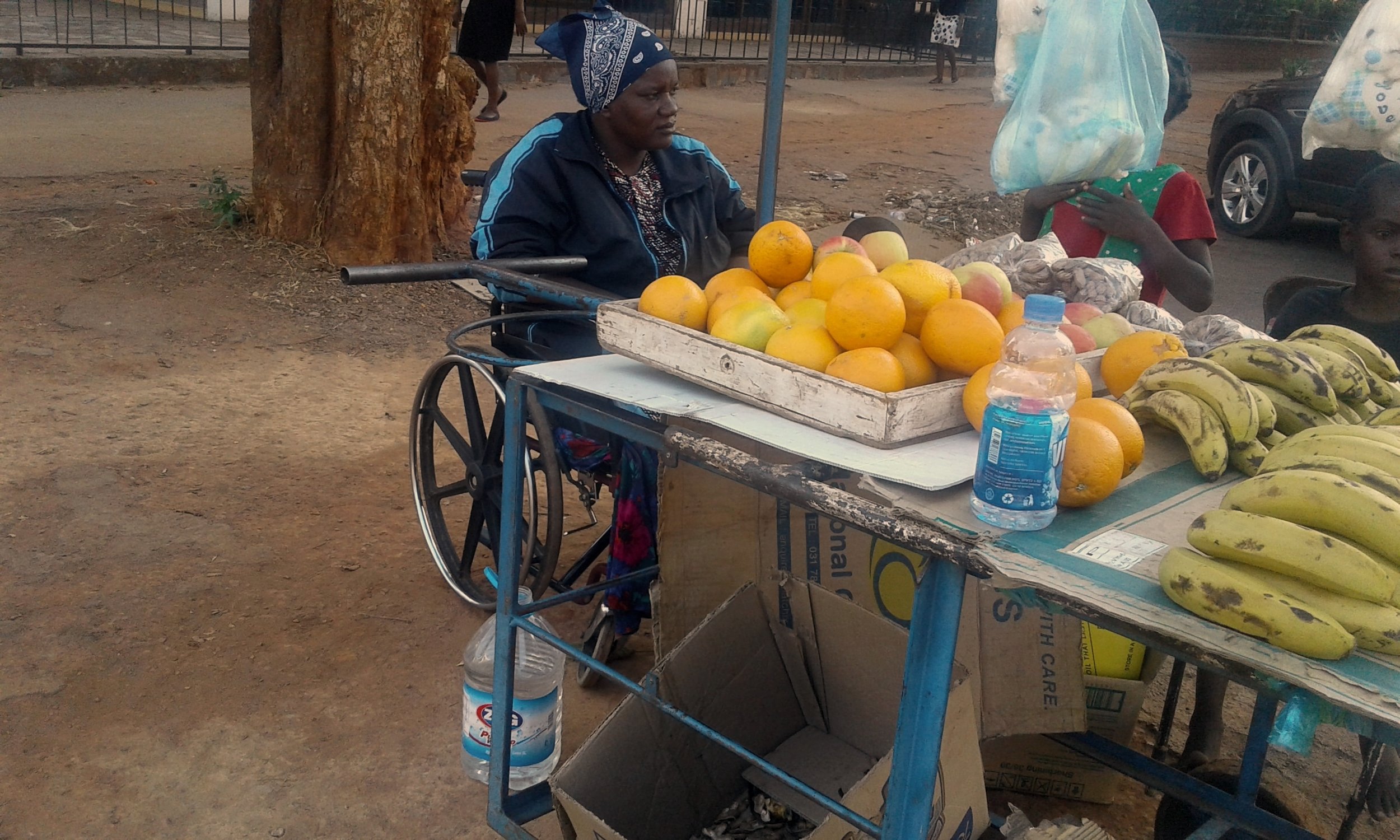
Disabled woman at her informal fruit and vegetable stall

Disabled woman at her informal fruit and vegetable stall

Dr Christine Peta

Dr Christine Peta

Dr Christine Peta with disabled women soon after a focus group discussion on sexual and reproductive health

Dr Christine Peta with disabled women soon after a focus group discussion on sexual and reproductive health