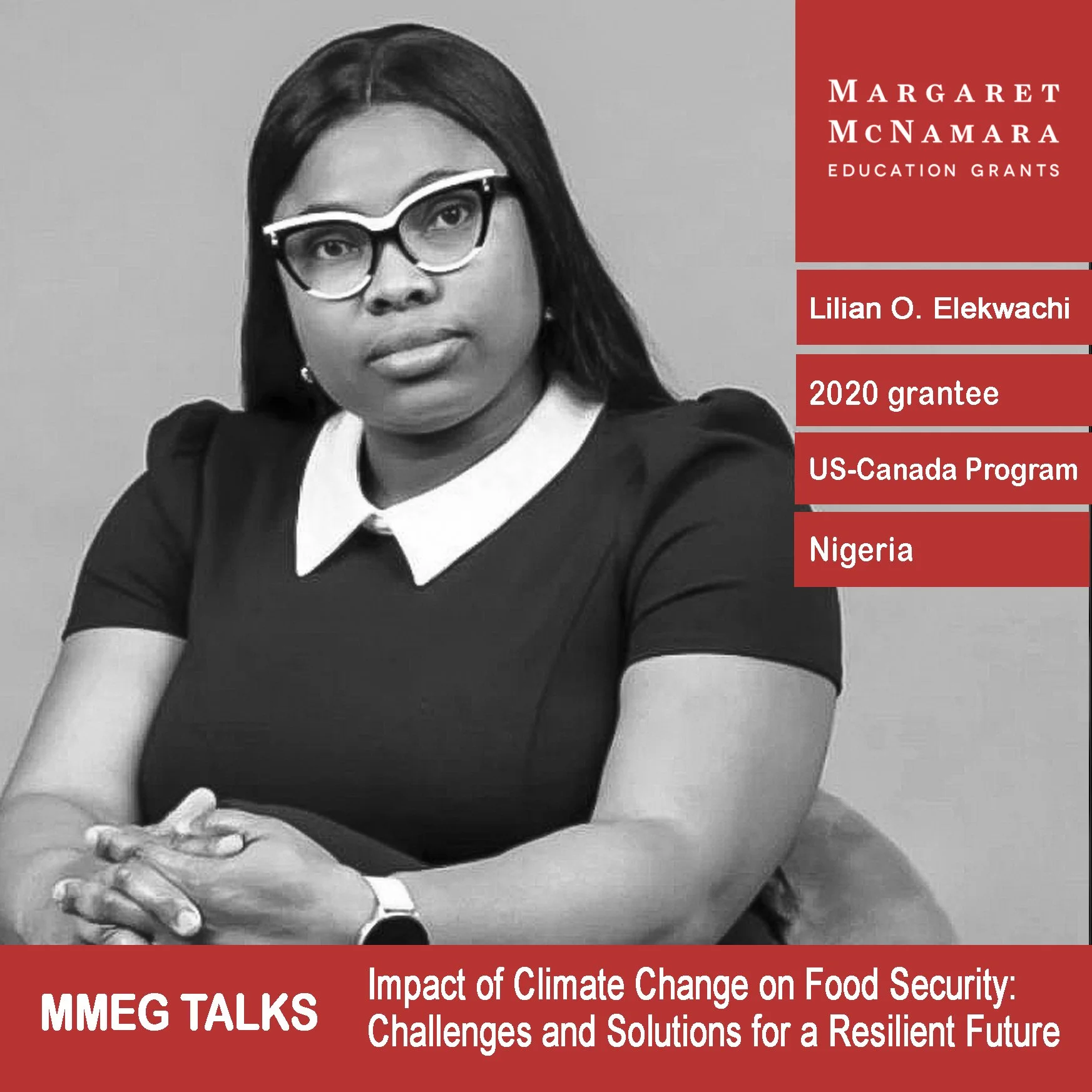
Lilian Elekwachi, a dedicated sustainable aqua culturist, is pursuing a PhD at the University of Massachusetts Boston. Also affiliated with MIT’s D-Lab, she has made notable contributions to the fishery/aquaculture field. Her wealth of experience, accolades, and published works reflect her commitment to promoting and fostering a more sustainable future.
Oluchi Ezekannagha

Oluchi, a 2017 MMEG grantee, holds a Ph.D. in nutritional sciences and has more than a decade of experience in the intersection of nutrition, agriculture, and health. She has contributed to shaping the Research and Innovation Strategy 2030 at CGIAR (Consultative Group on International Agricultural Research) and led their COVID-19 country work. Currently, she is focused on measuring and aggregating CGIAR’s longer-term impacts. Previously, Oluchi worked with Dalberg Advisors, IITA, and on a range of consultancy portfolios. Her main focus is strategic analysis and policy recommendations. She has worked with diverse stakeholders from the private sector, public sector, and NGOs, and is passionate about evidence-based solutions to improve nutrition outcomes and food security in low- and middle-income countries.
Batool Fatima

Batool, a 2011 MMEG grantee, is a public health and global mental health professional serving as an assistant professor in the Department of Community Health Sciences at Aga Khan University, Pakistan. She earned a DrPH in public health from Boston University while on a Fulbright scholarship. She also received an MMEG grant to support her doctoral thesis work. Batool’s research has been published in various local and international journals.
She has been serving as a consultant for public health assignment including project evaluation and has conducted training classes on a variety of topics, including voluntary counseling and testing for HIV/AIDS (VCT), reducing stigma and discrimination for HIV/AIDS, life skills development, and social and behavior change communication.
Thandeka Tshabalala
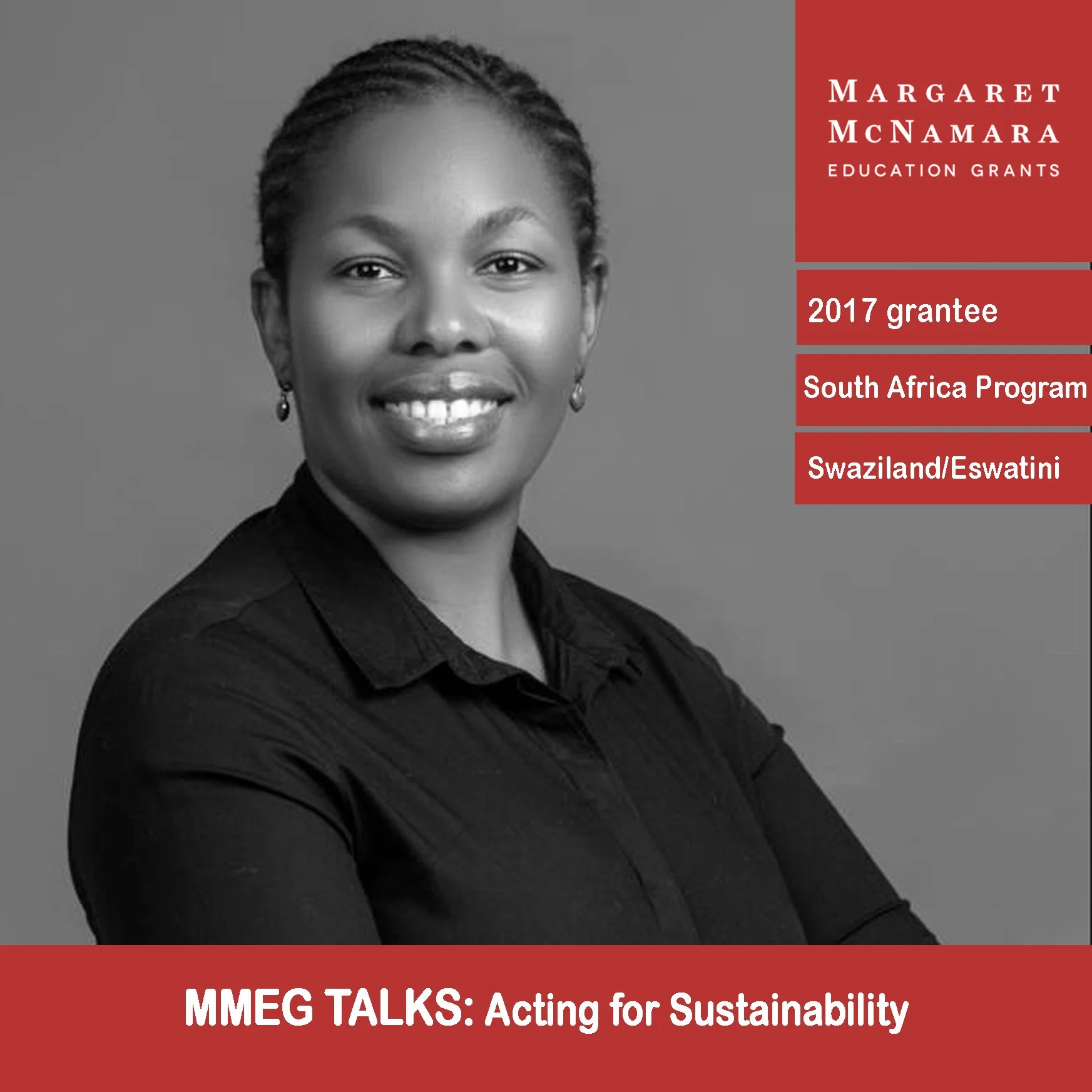
Thandeka, a 2017 MMEG grantee, is an urban planner and development practitioner. She holds an MPhil in development studies from the University of Cape Town and a BSc (Hons) degree in urban and regional planning from the University of Witwatersrand. She was employed at the South African SDI Alliance, where she collaborated with local communities to develop upgrading projects for informal settlements. Working with ICLEI Africa, she contributed to climate action integration in urban planning processes across African cities. Currently employed by the city of Cape Town, she focuses on the alleviation of energy poverty, while pursuing a PhD at the Centre for Sustainability Transitions at Stellenbosch University.
Nohora Constanza Niño Vega

Nohora Constanza Niño Vega, from Colombia, is a 2016 Latin America and Caribbean Program MMEG grantee.
Nohora is a National Council for Science and Technology (CONACYT) researcher at the Children’s Research Observatory (ODIN), El Colegio de Sonora, Mexico. She leads a project analyzing violence in Sonora from the perspective of its children and adolescents, including those traveling through to seek asylum in the United States. Working on such a complex subject impels Nohora to go beyond analysis to help create policies that minimize the impact of that violence on the lives of children and youths.
Nohora was trained as a psychologist at the National University of Colombia and holds MAs in development studies and in social sciences, and a PhD in research in social sciences with a minor in sociology from FLACSO-Mexico. Her areas of focus include children/youth in armed violence contexts, forced displacement, human security, gender, and peacebuilding processes in Colombia and Mexico, particularly on the Sonora/Arizona and Norte de Santander/Táchira borders.
She began her career as a research coordinator on a project in Tijuana, developing human security agendas in a neighborhood suffering from insecurity violence. Since then, she has collaborated on numerous research projects, including on education for peacebuilding in Medellín and Acapulco, with the University of Glasgow and Colombia’s Fundación Ideas para la Paz. She has researched Venezuelan child and youth migration on the Colombian-Venezuelan border and that of Mexican children and young migrants/refugees on the US-Mexico border. Nohora says, “I am very excited to work on collaborations that directly involve the community; that is what motivates me the most in research projects.”
In addition to her research, Nohora has taught at universities in Colombia, participates in numerous official and professional working groups on adolescents, youth, violence, and migration, publishing extensively on these subjects, and has worked as a psycho-social advisor for refugee children. Nohora now volunteers at a shelter serving internally displaced Mexican and Central American populations, drawing on her experience as a psychologist for such populations in Colombia.
Newer PostElizabeth Vargas Castellanos
Older PostLarisa Kasumagić-Kafedžić
Larisa Kasumagić-Kafedžić

Larisa Kasumagić-Kafedžić, from Bosnia and Herzegovina, is a 2004 US-Canada Program MMEG grantee.
Larisa is an advocate for peace and nonviolence through education. She is an associate orofessor at the Faculty of Philosophy of the University of Sarajevo and, currently, at Cornell University. As a 2022–23 Fulbright Visiting Scholar Fellow at Cornell, she lectures on and researches the role of teachers as agents of change in education for peace and social responsibility. She founded the Peace Education Hub at the University of Sarajevo in 2000.
Larisa holds an MPS in International Development and Education from Cornell University and a PhD in English language pedagogy and intercultural education from the University of Sarajevo. She was a 2003–04 Cornell University Hubert Humphrey Fellow. Her peace-building engagement began during the war in Bosnia and Herzegovina, when she worked on child war trauma, peace education, and nonviolent communication with teachers and schools in conflict-affected communities.
Larisa’s teaching, writing, and research focus on intercultural, critical, and peace pedagogies in teacher education and language and culture didactics. She recently published Peace Pedagogies in Bosnia and Herzegovina: Theory and Practice in Formal Education, which presents positive examples of successful pedagogical practices in the country and recommends the incorporation of peace pedagogies into formal teacher education.
Larisa has also published on the engagement of youth in community development. She is an advocate of incorporating peace education into community youth development programs in post-war Bosnia and Herzegovina; post-war healing and reconciliation through psycho-social support and pedagogical programs; working closely with schools and communities in nonviolence education; using participatory methods of community development; developing modules and educational methodologies of the “Facing History and Ourselves” program that focuses on civic education through teachings of the Holocaust and other instances of extreme violence across the world; and teaching nonviolent communication based on peace pedagogies and humanistic psychology principles.
Hourie Tafech

Hourie Tafech is a 2020 US-Canada Program MMEG grantee, from the West Bank and Gaza. She is a program manager at Refugees International in Washington DC. She is also an Advisor for the United States Refugee Advisory Board (USRAB) and a special Advisor for NASH Refugee Resettlement Initiative. She previously served as program manager for the University Alliance for Refugee and at-Risk Migrants and was a postdoctoral fellow at Guilford College, North Carolina.
Hourie earned her PhD in global affairs from Rutgers University, and her research focuses on refugee economic integration and entrepreneurial activities. In 2021, Hourie was awarded an international fellowship from AAUW. In Malta, before coming to the United States, Hourie co-founded Spark15, the first refugee-led organization recognized by the United Nations High Commissioner for Refugees (UNHCR). As president of Spark15, she advocated for the rights of refugees in Malta before the Office of the President of Malta, the Minister for European Affairs and Inclusion, the Ministry of Education, and UNHCR-Malta.
Hourie’s most recent publication reviews the US refugee resettlement program and examines refugee entrepreneurship in US cities, finding that cities with a smooth business registration process, affordable housing, active resettlement agencies, and minimal social and political discrimination are most encouraging of refugees’ economic inclusion.
Fatima Omarjee Ebrahim
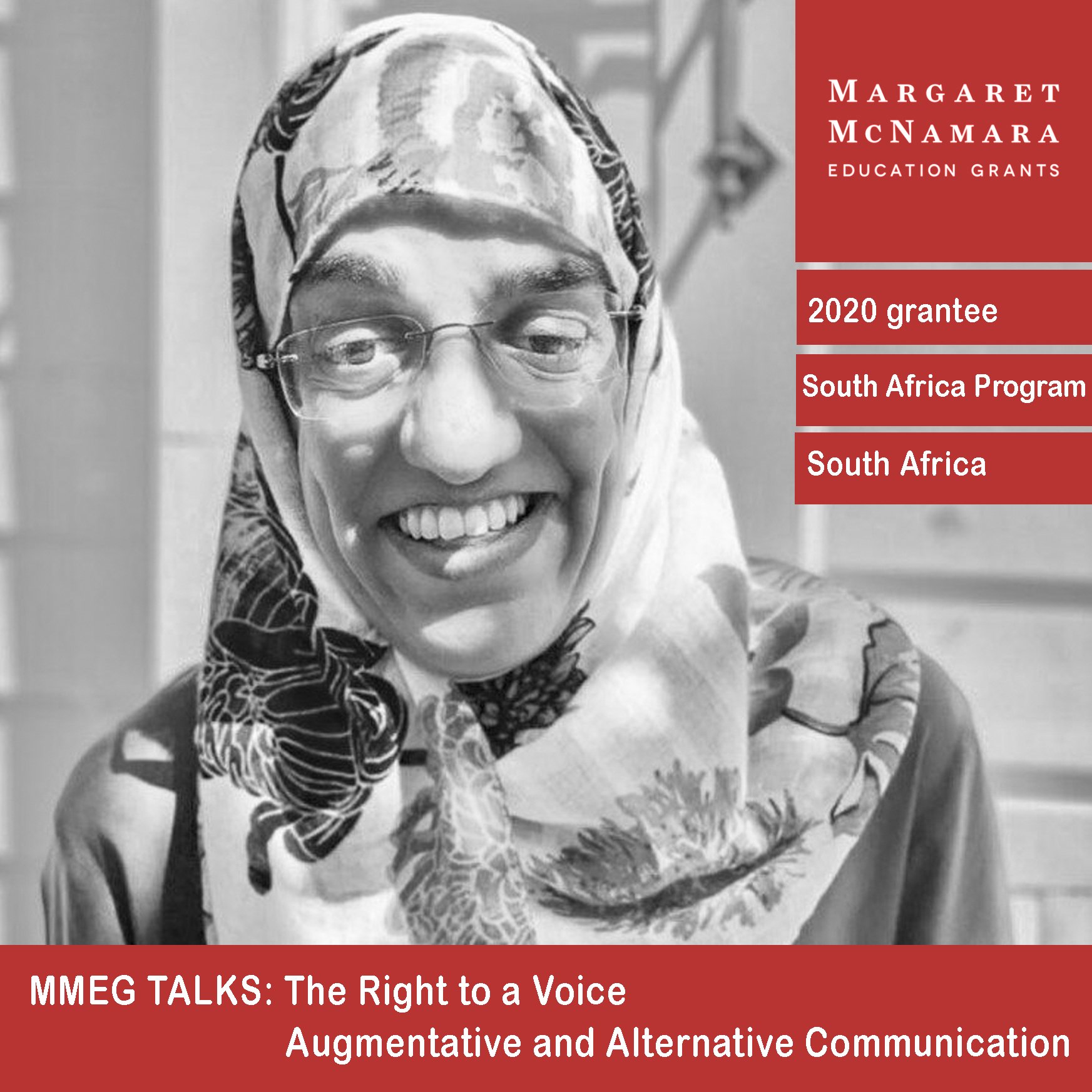
Fatima Ebrahim is a 2020 South Africa Program grantee. She is pursuing a master’s degree in occupational therapy at the University of Cape Town. Faatima Ebrahim is South African clinical occupational therapist with 20 years’ experience serving the disabled community primarily in pediatric practice, and in a public health managerial capacity. Having a special needs child opened her eyes to the heavy burden on - almost exclusively female – caregivers, and radically changed her views on the role of the therapist. Ebrahim returned to university to better equip herself to research and advocate for caregiver engagement in therapy, as well as promoting inclusive communities, where those with disabilities can integrate and thrive, in collaboration with relevant NPOs.
“I grew up in apartheid South Africa. It was only in my first year at university that I was exposed to other cultures and communities within my own country. My parenting journey of a child with special needs has been a significant influence on the way I view my work. My own lived experiences of discrimination have empowered me to own my identity, and created a yearning for me to create and build the capacity of other women and children.”
Netsai Gwata

Netsai Gwata is pursuing a doctorate in educational psychology at the University of Pretoria, South Africa, while working as an educational psychologist at Brighter Futures for Children in the United Kingdom. She is investigating the resilience-enabling factors that protect young adults from resource-constrained or stressed communities from depression.
Netsai herself comes from a resource-constrained community in Zimbabwe. However, thanks to her own perseverance and support from family and community members, she was able to do well in life. As an educational psychologist, she wants to champion the resilience of young people in similarly disadvantaged communities.
Her professional goal is to help open learning centers for children with learning disabilities that are accessible to families from resource-constrained communities. In Zimbabwe, most children and young people with learning disabilities from such communities have limited access to education that is suited to their needs.
Vuledzani Ndanganeni

Vuledzani Ndanganeni is a speech-language pathologist and audiologist with 15 years of experience, including in South Africa’s public sector; at a school for children with special educational needs and developmental disabilities; and in an adult neuro rehabilitation center, dealing with patients with spinal cord injuries and acquired and congenital neurological problems.
Vuledzani is completing her PhD at the University of Pretoria’s Centre for Augmentative and Alternative Communication (CAAC), where she also earned BA Honours and Master’s degrees.
Vuledzani’s research interests are early childhood intervention and AAC; cultural, linguistic, and contextually relevant interventions; community-based rehabilitation for persons living with disabilities and severe communication disorders in low-resourced contexts; and dysphagia in children and adults. She is passionate about transformation and managing diversity as well decolonization in the speech-language and audiology professions.
Ensa Johnson

Ensa Johnson is an augmentative and alternative communication (AAC) specialist and special needs educator. She completed her PhD studies at the Centre for Augmentative and Alternative Communication, University of Pretoria, South Africa, in 2015, where she focused on determining pain vocabulary that children aged 6–9 use to communicate their pain. This enabled speech-language pathologists to identify vocabulary for children with complex communication needs to use on their communication boards or speech-generating devices. Ensa received a MMEG grant in 2015 to financially support the completion of her PhD, as well as as well as a National Research Foundation (NRF) sabbatical grant.
Since completion of her doctoral studies, Ensa’s research has focused on children’s pain communication and pain assessment, in collaboration with Prof. Stefan Nilsson. Currently, Ensa is the South African primary investigator, with Prof. Nilsson as her Swedish counterpart, in a collaborative research project that resulted in the development of the PicPecc app to help children undergoing cancer treatment. This project has resulted in numerous publications.
In addition to her research in pain communication and assessment, Ensa is researching the implementation of AAC in various settings, including hospital intensive care units, schools, and courts. Ensa is rated by the NRF as an established researcher (C2 rating). To date, she has published more than 30 articles in peer-reviewed journals as well as 3 chapters in scholarly books.
Ensa worked for 11 years at the Centre for AAC and has been employed since January 2022 as a lecturer at the University of South Africa’s Department of Inclusive Education. She has supervised two PhD students and co-supervised three PhD students to successful completion as well as supervising or cosupervising 15 MA students to completion. She is currently supervising two PhD students and 7 MA students.
Detailed information on Dr. Johnson’s work and publications: https://www.unisa.ac.za/sites/corporate/default/Colleges/Education/Schools,-departments,-centres-&-instututes/School-of-Educational-Studies/Department-of-Inclusive-Education/Staff-members/Dr-E-Johnson