June 23, 2024
MMEG Grantees Tackle Climate Change and Food Security
By Lindsey Chang
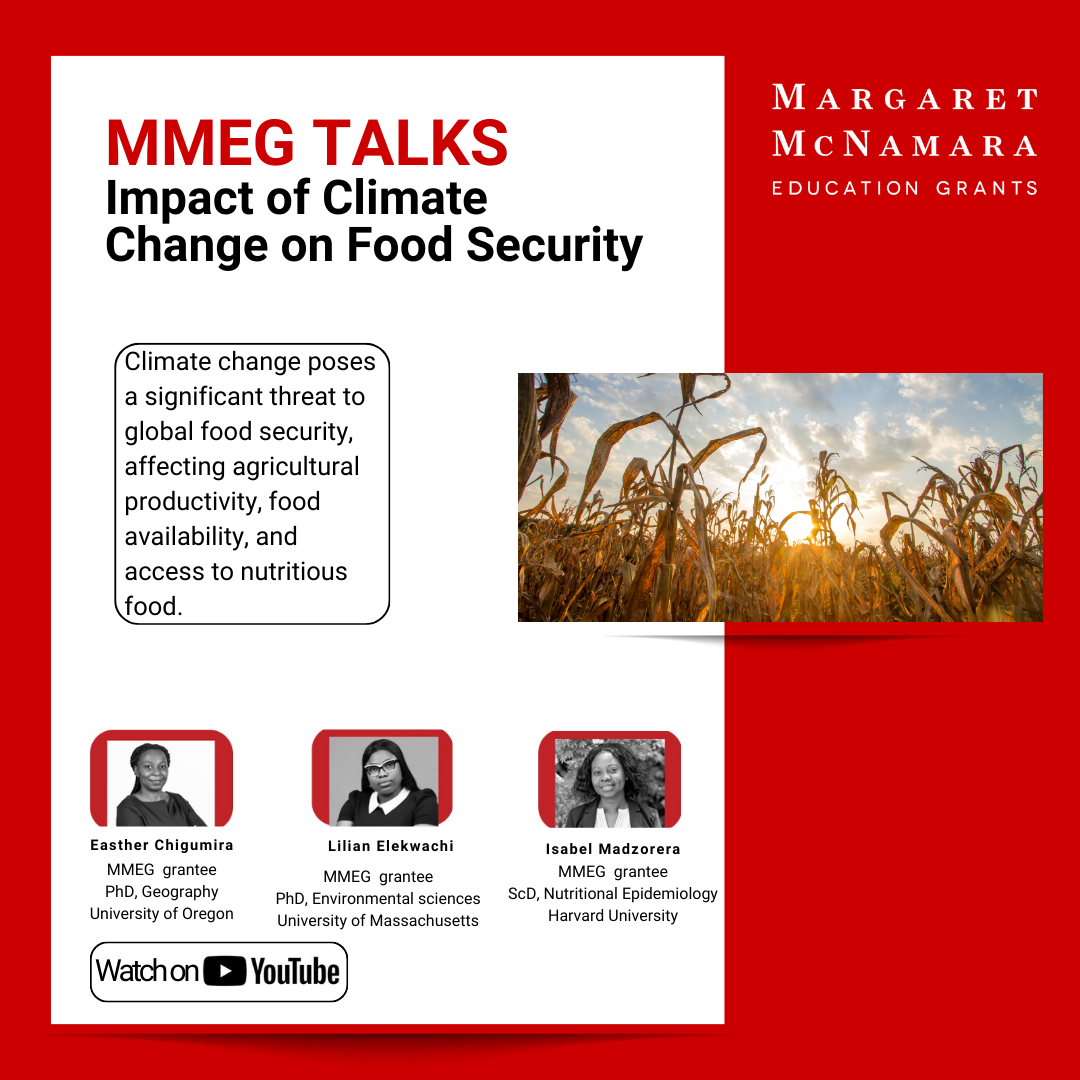
On June 12, 2024, Margaret McNamara Education Grants (MMEG) hosted a panel discussion at the World Bank on the impact of climate change on food security. This event highlighted the groundbreaking work of three MMEG grantees: Easther Chigumira (2013), from Zimbabwe, Lilian Elekwachi (2020), from Nigeria, and Isabel Madzorera (2005), from Zimbabwe. These remarkable women shared their research and personal experiences, emphasizing the critical role of education and innovation in addressing the global food security challenges posed by climate change.
Holger Kray, an agricultural economist with extensive expertise in agricultural policy and climate-smart practices, set the stage for a compelling discussion. He introduced the panelists, three outstanding MMEG grantees whose work exemplifies the power of education and innovation.
Discussion Highlights: Innovation, Resilience, and Policy
The webinar explored several vital topics, illustrating the importance of innovative solutions and resilience in the face of climate change. Key areas of discussion included:
Innovation in food systems: Isabel Madzorera, a nutritional epidemiologist, discussed the broken state of food systems, particularly in sub-Saharan Africa. She emphasized the need for technical expertise and funding to bridge the gap between climate data and nutritional outcomes. Isabel's research sheds light on how climate change affects food production and nutritional quality, highlighting the importance of innovative approaches to improve food security.
Resilient technologies: Lilian Elekwachi, a researcher and sustainable aquaculturist, shared her journey of developing a hybrid fish smoking technology. This innovation addresses health hazards, environmental degradation, and inefficiency associated with traditional fish smoking methods. By significantly reducing the smoking process and enhancing food safety, Lilian's work exemplifies the resilience needed to adapt to climate change's impact on food systems.
Policy and agricultural transformation: Easther Chigumira, a geographer and policy advisor, presented an overview of Zimbabwe's climate challenges, focusing on how frequent droughts and extreme weather events affect food security and economic growth. She highlighted the success of digital climate advisory services in reaching thousands of farmers and boosting their yields. Easther stressed the importance of partnerships and knowledge sharing to scale effective solutions, demonstrating the vital role of policy in agricultural transformation.
Closing Remarks
In his closing remarks, Anup Jaguani, Senior Global Sector Manager for Agribusiness and Forestry at the IFC, reflected on the theme of resilience, sharing personal anecdotes and highlighting the importance of public-private partnerships in addressing agrifood sector challenges. Anup praised MMEG for supporting champions in their fields and reaffirmed the commitment of the World Bank and IFC to scaling up successful agricultural technologies.
The event underscored the transformative impact of MMEG grantees, showcasing how these exceptional women are driving change and creating a more resilient and food-secure future. The discussion concluded with optimism and determination to continue the vital work of addressing climate change and its effects on food security.
MMEG Talks are organized by MMEG board member Priscilla Linn, who welcomes suggestions for future MMEG Talks subjects.
Watch the whole Talk here
February 6, 2024
Equity for Women in the Workplace
By Lindsey Chang
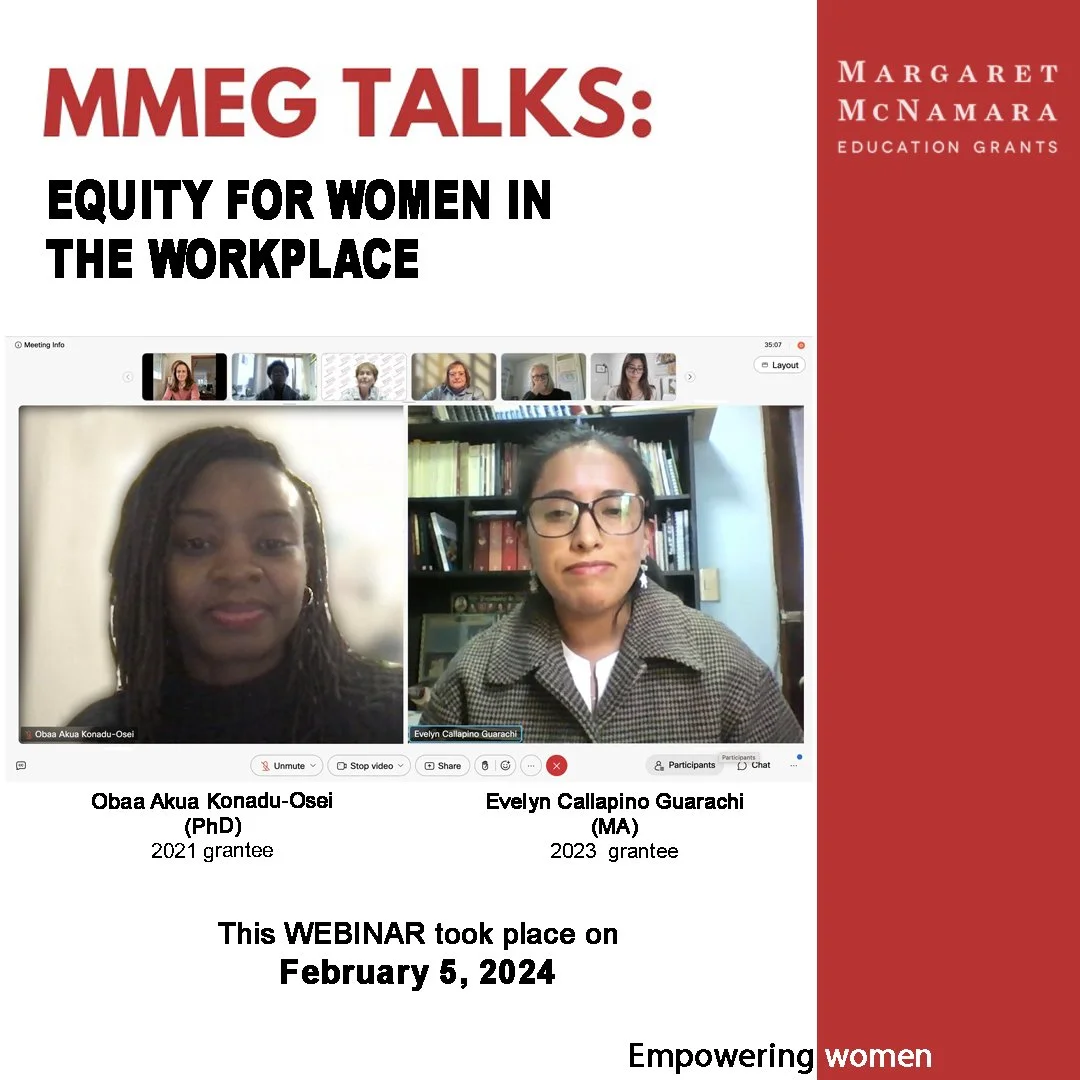
Examining the landscape of gender equity in mining, Margaret McNamara Education Grants (MMEG) hosted a thought-provoking webinar titled "Equity for Women in the Workplace" on February 5, 2024. The event delved into the experiences of women miners in Ghana and Bolivia, exploring the challenges they face and the potential for transformative change through education and policy initiatives.
In this session, Obaa Akua Konadu Osei from Ghana and Evelyn Callapino Guarachi from Bolivia, both MMEG grantees, shared their insightful research and personal experiences that underscore the resilience and empowerment of women navigating the challenges of a traditionally male-dominated field. Their stories, rooted in their families’ experiences in mining, were a compelling testament to the critical need for gender equity and the potential for transformative change within the industry on a global scale.
Discussion Highlights: Education, Resilience, and Change
The webinar delved into several critical issues, underscoring the importance of education as a catalyst for social resilience and empowerment. Key topics included:
Education as a tool for empowerment: The panelists highlighted how educational support is crucial for enabling women to navigate and excel in challenging environments.
Resilience in a men’s world: The conversation addressed the resilience of women working in mines traditionally dominated by men, where even job postings often implicitly favor male candidates. Despite such barriers and having to overcome their own doubts and societal stereotypes suggesting they might not succeed, these women not only entered these fields, but they are able to become upwardly mobile.
Empowering change: Advocating for the recognition of women miners, whose contributions have historically been overlooked, is crucial to raise social awareness about their work conditions and risks. Supporting women's organizations who push for public policy changes is essential to secure advancements and protections for women in mining. The importance of acknowledging and rectifying women’s marginalized status in the industry was also discussed.
Achievements and the Path Forward
The achievements of Obaa and Evelyn serve as a testament to the potential of focused aid in effecting significant changes in gender equity and beyond. Their work not only sheds light on the specific challenges women face in industries like mining but also offers strategies for upward mobility and empowerment.
The stories of Obaa and Evelyn underscore the transformative power of education and the importance of sustaining efforts to achieve gender equity in the workplace and society at large.
This MMEG Talk served as a powerful reminder of the collective action needed to support and uplift women worldwide, particularly in challenging sectors and circumstances.
MMEG Talks are organized by MMEG board member Priscilla Linn, who welcomes suggestions for future MMEG Talks.
To view the whole Talk press here.

June 20, 2023
Ex-Refugee Turned Advocate Shares Her Journey
By Daniel Amponsah, FCV Communications Team
Refugee youths are highly unlikely to attend college. UNHCR data sadly backs this up: only 1 in 100 refugee youth enrolls in tertiary education compared with nearly 40 in 100 of the world's youth, according to the agency's analysis. Yet Dr. Hourie Tafech, a young Palestinian woman born in a Lebanese refugee camp, defied the odds. Not only did she go to college, but she also earned a doctorate degree in global affairs. In 2020, Dr. Tafech was awarded the prestigious Margaret McNamara Education Grant in recognition of her work as a passionate advocate for refugee rights. In a conversation with Soukeyna Kane, Director, Fragility, Conflict, and Violence (FCV) Group, Dr. Tafech talks about her experience, her work, and about issues related to forced displacement.
Soukeyna: You spent your entire childhood in Lebanon as a Palestinian refugee, which I'm sure carried a lot of trauma and suffering. How did you turn that experience into becoming an advocate for refugees?
Hourie: I'm a third-generation Palestinian refugee, born and raised in Lebanon. It was my grandfather who was forcibly displaced during the 1948 Palestinian War. I must say the refugee situation might have improved a bit from 1948, but it is almost the same in terms of the inability to enjoy political and civil rights in Lebanon. When I was growing up, we could not afford to live outside the camp and were not allowed to be employed in certain jobs. Since the camps are considered autonomous zones, the government is not responsible for what happens inside. Groups in the camp clashed with each other frequently. Without going into details, I can say that growing up in the camp was traumatizing in terms of personal safety.
I am here today not because I had the power to transform my life. I believe my determination, skills and hard work, though important, would hardly be enough. I benefited from encountering the right people and opportunities along the way. I was one of the luckiest refugees who had opportunities and met people who believed in and took a chance on me.
Soukeyna: Given your experience and your research, what would say are the main challenges to the full integration of refugees into host communities and what do you think can be done about them?
Hourie: I think a key challenge is that we look at the refugee situation through a temporary lens. Palestinian refugees in Lebanon, for instance, have been in permanent temporariness' for 75 years. Another challenge is that host communities have their own development problems. The public perception toward refugees is often unfavorable. Blaming refugees and migration for host countries' every problem instead of focusing on substantive issues is often popular during political campaigns. It makes people hate refugees. Yet refugees should also bear some responsibility for their integration into host communities. Refugees must respect the laws and environment of host countries and refrain from meddling in politics. To better integrate refugees, I think we should have long-term plans with right policies, programs and institutions in place. We must also make sure that the public is well informed and political campaigns avoid spreading negativity about refugees.
Soukeyna: How can the World Bank or other multilateral organizations help with refugee integration?
Hourie: I think World Bank needs to be more vigilant with issues related to fraud and corruption when it supports governments for refugee integration. The multilateral organizations must make sure the money they provide to governments is used for its intended purpose. I think a strict transparency and accountability system will be critical to track how the money is spent and whether it is reaching the refugees and host communities.
Soukeyna: How do you stay optimistic working on this challenging issue?
Hourie: Believe me, I'm not always optimistic. I have moments when I get overwhelmed, feeling the challenge is too daunting. Yet I cannot help but be hopeful when I recall how access to higher education has changed my life, helping give my family a good life outside the camp. At the same time, I have helped my brothers, cousins and others to secure scholarships to go to university. I have realized that helping each other at the family and community levels could lead somewhere.
I am happy, too, with the progress made in getting refugees involved in important policy dialogues. Next week, I will be the first refugee representative in the official U.S. delegation to the Annual Tripartite Consultation on Resettlement—a UNHCR forum on global refugee resettlement—in Geneva. I wouldn't have imagined that eight years ago.
Dr. Tafech also had a question for Soukeyna

Hourie: Does your department include refugee voices and leadership, or refugee-led organizations when it comes to planning for FCV countries?
Soukeyna: On the refugee situation, our main counterpart is UNHCR because they help us assess protection frameworks when we design projects. When we plan on using the [IDA] Window for Host Communities and Refugees—the World Bank's support for durable solutions and socio-economic opportunities for refugee and host populations—we have consultations with the beneficiaries. At the corporate level, we engage NGOs, including refugee-led ones in policy dialogue.